Redefining Bedroom Luxury
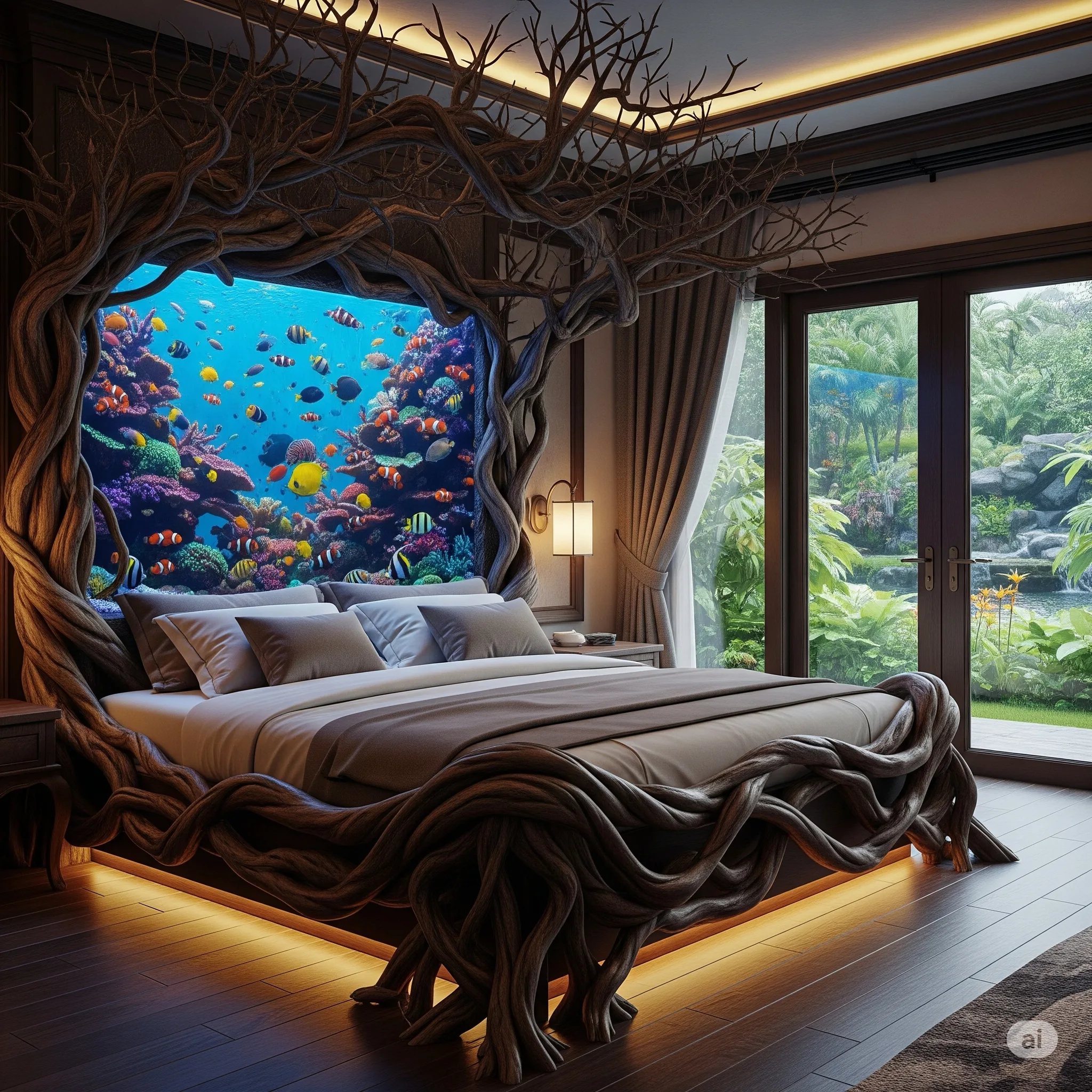
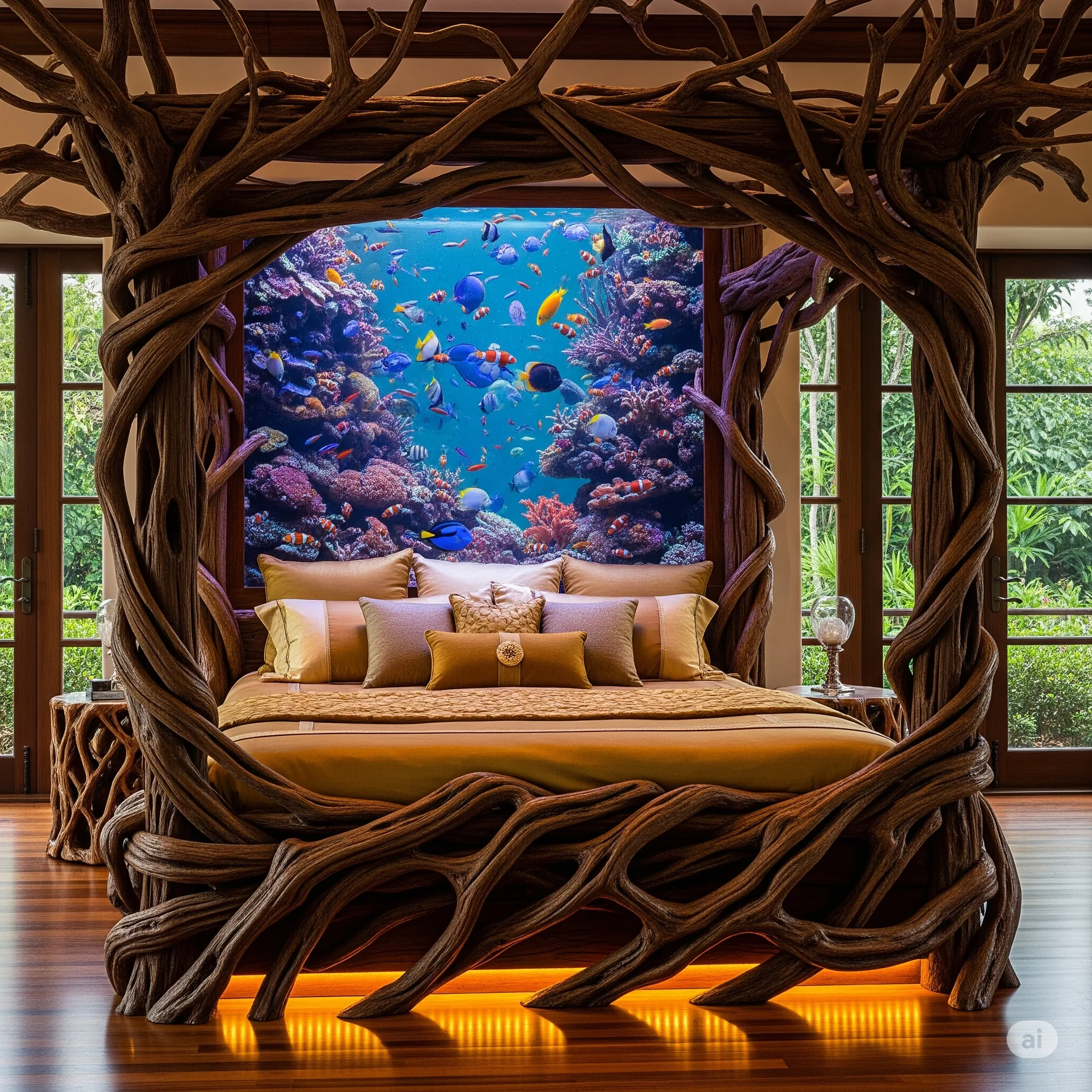
A wooden aquarium bed is more than furniture; it is an idea that collapses architecture, craft, and living ecosystems into a single, inhabitable object. Imagine a bed whose headboard glows with a planted freshwater wall, whose footboard reveals a shallow reef panel, or whose under-mattress cavity contains a panoramic aquarium that throws rippled light across linen at night. A wooden aquarium bed blends the tactile warmth of timber with the slow-motion spectacle of aquatic life, turning sleep and private ritual into a multisensory, restorative practice. Choosing a wooden aquarium bed is choosing a lifestyle that privileges calm, craftsmanship, and a daily encounter with living systems—an investment not only in design but in wellbeing. This article explores why wooden aquarium beds are the perfect and unique choice: the design typologies available, technical and engineering realities, ecological considerations, installation and maintenance expectations, safety and regulatory issues, and the aesthetic and emotional rewards these hybrid pieces bring to modern interiors.
The essence: why wood + water + bed?
Wood connects to home in a way cold materials rarely do: grain, warmth, and tactility create comfort. Water—when curated as an aquarium—introduces motion, subtle sound, bioluminescent-blue light, and living color. A bed is the most intimate piece of furniture; it structures rest and ritual. Combining these three elements makes a persuasive proposition: the wooden aquarium bed becomes a sanctuary object that soothes both body and mind. Scientific research on aquaria supports the calming effects of watching fish and plants; pairing that with the restorative function of sleep multiplies the design’s meaning. Practically, the wooden frame offers an artisanal canvas and structural capacity to integrate tanks, while careful engineering preserves both wood and water for decades.
Typologies and forms: how wooden aquarium beds are designed
Wooden aquarium beds come in many forms, each solving different architectural, ergonomic, and maintenance challenges.
Headboard aquarium
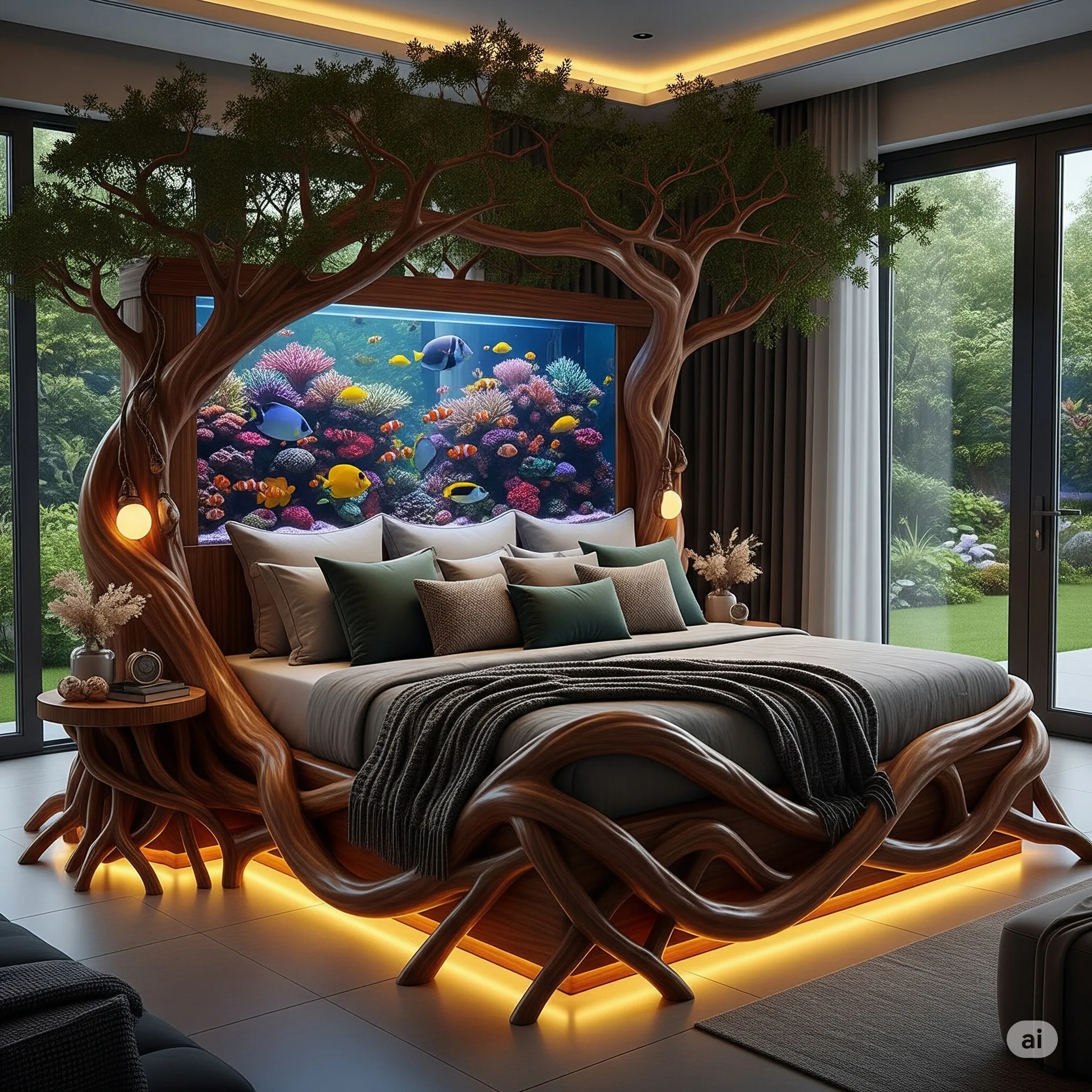
The most common approach integrates a vertical aquarium into the headboard zone. This typology maximizes visibility and accessibility while minimizing structural load on the floor. A headboard tank can be a shallow planted wall or a deeper marine tableau, framed by solid timber. It is often paired with bedside service panels to hide pumps and filtration systems.
Under-bed aquarium
An under-bed aquarium places a horizontal tank beneath a raised mattress platform. From a design standpoint it creates cinematic illumination that washes ceilings and elevates the bed visually. Structurally it requires careful load distribution—filled tanks are heavy—and well-planned service access (removable panels or drawer-like sumps).
Integrated frame aquarium (footboard or side panels)
Tanks can be inset into the footboard or side rails as panoramic panels. These framed aquaria create intimate viewing corridors and can be easier to maintain than under-bed tanks because they often provide direct front access.
Hybrid beds with removable liner
Hybrid designs use a metal or composite liner for water containment inside a wooden shell. This decouples structural concerns and simplifies sanitation: wood becomes aesthetic cladding rather than the water-bearing element, and liner replacements are possible down the line.
Modular and multi-tank systems
Some designs distribute several smaller tanks within a broader wooden frame—vertical columns for planted scapes or shallow trays for growing specific species. Modularity helps isolate problems and reduces risk of a single catastrophic leak.
Materials and timber choices: balancing beauty and stability
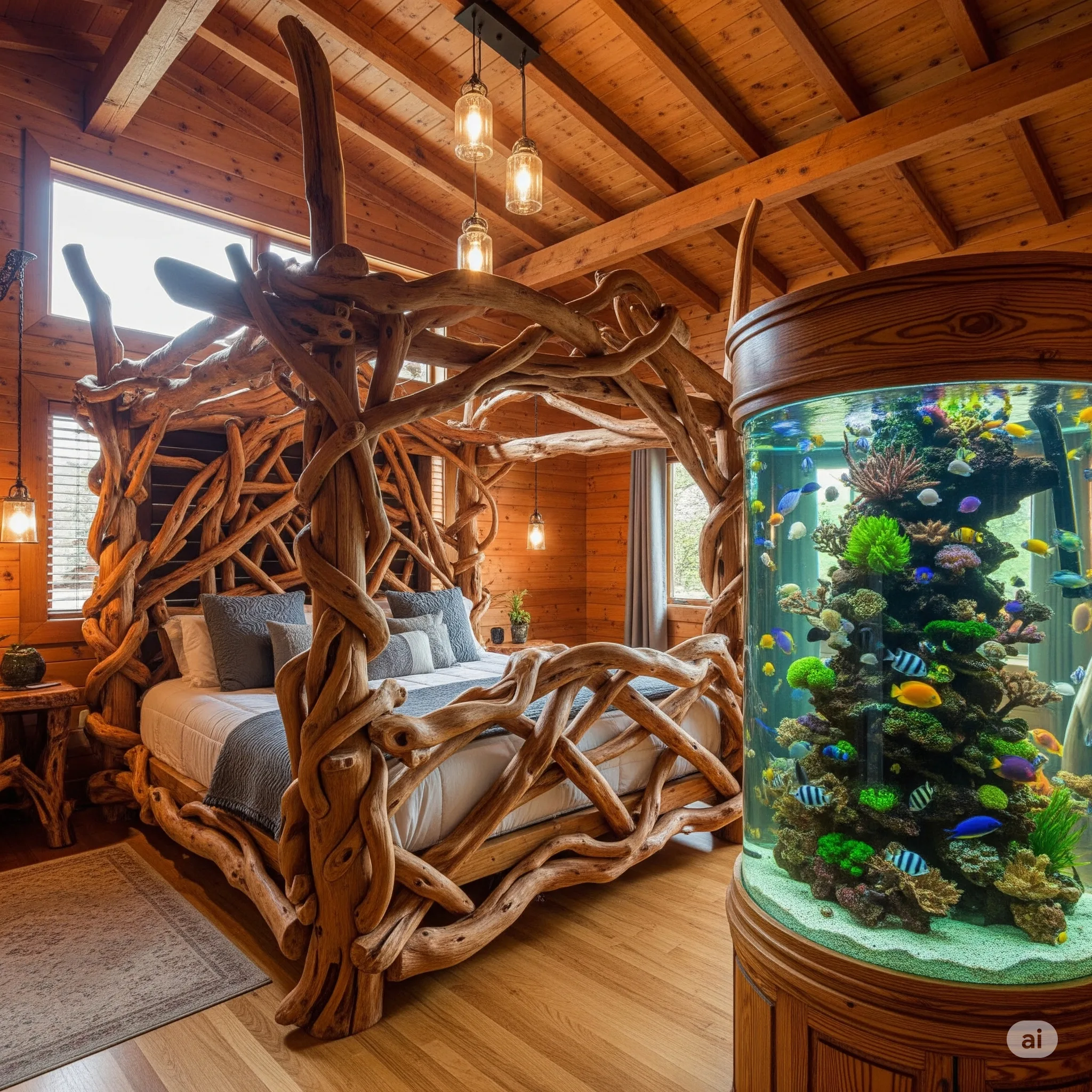
Selecting the right timber is critical because wood reacts to moisture and humidity. Preferred choices for visible cladding and structural components include teak for its natural oils and rot resistance, oak for structural integrity and grain, walnut for luxurious warmth, and cedar for aromatic interior spaces. For internal frames and load-bearing structures, engineered woods—marine-grade plywood, laminated beams, or cross-laminated timber—offer dimensional stability and predictable behavior in fluctuating humidity. For under-mattress and floor frames that support tank weight, steel-reinforced subframes filled into the timber frame provide safety and longevity.
Finishes must be chosen with care: penetrating oils (tung or polymer-modified oils) bring out grain while maintaining tactile warmth, while high-performance clear varnishes or marine-grade polyurethane provide resistant barriers. Food-safe sealants in areas of human contact ensure health compliance. For exterior finishes, UV-stable coatings reduce color shifts under sunlight.
Tank engineering: glass vs. acrylic, liners, and secondary containment
Aquarium construction is the technical heart of a wooden aquarium bed. Two major materials are used for tank walls: tempered glass and acrylic. Glass is scratch-resistant, offers optical clarity, and feels substantial; however, large glass panels are heavy and need thick sections to resist bowing. Acrylic is lighter, impact-resistant, and allows complex curves and seamless bonding—ideal for panoramic under-bed installations where weight and form matter.
A dual-system strategy is strongly recommended for safety: an inner watertight liner (glass or acrylic) contains water while the outer wooden shell frames and insulates. Secondary containment—drip trays, perimeter gutters, or a floor drain routed catchment—is essential. If a leak occurs, these systems direct water safely to a drain or collection reservoir rather than into finished timber or subfloor structure.
Engineering considerations include panel thickness calculations (based on surface area and water depth), stainless-steel or aluminum stiffeners to limit bowing, and bonded joints with marine-grade silicone. For modular or removable tanks, quick-disconnect plumbing and labeled unions ease service and replacement.
Structural and subfloor requirements: understanding the weight of water
Water is heavy—approximately 8.34 pounds per gallon (3.78 kg per 3.78 liters). Even a modest under-bed aquarium of 100 gallons represents over 800 pounds (360+ kg) before adding rockwork, equipment and the mattress. These loads demand early involvement of a structural engineer. Typical strategies include:
- Concentrating loads over load-bearing walls or reinforced pads.
- Installing steel subframes that distribute forces to multiple joists or direct-bearing supports.
- Using adjustable leveling feet to cope with small planarity differences.
- For second-floor installations, installing reinforced beams or sistering joists to meet deflection and shear limits.
Designers plan load paths carefully: the tank’s weight should not be borne solely by thin wood panels or furniture-type legs. Anchor points and lateral bracing are used to prevent shifting during maintenance and to resist seismic loads where relevant.
Plumbing, filtration and service access: making the ecosystem invisible but accessible
Successful wooden aquarium beds integrate filtration, heating, pumps, and lighting while maintaining clean visual lines. Common service strategies:
- External sump approach: The sump (an auxiliary tank with filtration media) is located in a bedside cabinet, closet, or adjacent furniture. Plumbing uses bulkhead fittings and flexible hose unions to connect the display tank to the sump, simplifying maintenance.
- In-frame sumps with access drawers: For tight spaces, the sump can be housed within the bed’s base behind removable drawers or panels, making servicing possible without major disassembly.
- Concealed piping channels: Routed cavities within the wooden frame carry wiring and tubing safely, accessible via removable panels.
- Quick-disconnect unions and labeled valves: These make winterization, draining, and component replacement manageable.
- Electrical code compliance: All electrical components—heaters, controllers, lights—must be GFCI protected and installed per local codes. Power strips and controllers should be in ventilated, drip-proof enclosures.
Good design builds in generous service clearance; technicians must be able to swap a pump or a heater without dismantling the bed.
Lighting design and circadian considerations
Aquarium lighting must serve both ecological needs (plant photosynthesis, coral health) and human comfort (bedtime light profiles). For bedroom use, minimize blue-rich light at night because it can suppress melatonin and disrupt sleep. Strategies include:
- Tunable LED systems: Allow daytime full-spectrum light for the tank and a warm, dim “moonlight” mode in the evening.
- Programmable ramps: Simulate dawn and dusk gradually to reduce abrupt light changes that disturb sleep.
- Localized baffling and diffusers: Prevent direct glare into occupants’ eyes by using backlit panels and indirect fixtures.
- Light placement: Consider placing higher-intensity lamps within the back or top of the tank while using wavelengths and intensity that meet the needs of plants or corals.
In short, lighting must satisfy aquarium life while supporting human circadian health.
Sound, vibration and sleep hygiene
Mechanical noise—pumps, fans, air stones—can affect sleep quality. Vibration isolation and acoustic planning help retain the aquarium’s calming effect without introducing disturbance:
- Use low-RPM pumps and anti-vibration mounts to decouple mechanical energy from the bed frame.
- Place noisy equipment (large pumps, blowers) in separate cabinets with sound-damping foam or acoustic enclosures.
- Use flexible tubing and soft couplings to reduce structure-borne noise.
- For aeration, consider silent options like passive surface skimmers or quiet nebulizers instead of loud air stones.
A well-engineered system yields a soft, steady water sound that functions as a gentle white noise rather than a disruptive hum.
Ecology: freshwater planted vs. saltwater reef decisions
Choosing the type of aquarium defines long-term care. Freshwater planted tanks are often more forgiving, require simpler chemistry, and create lush green landscapes that promote calm. Reef saltwater tanks are vivid and spectacular but demand tighter parameter control and more frequent dosing (calcium, alkalinity) and filtration. Decision factors include:
- Maintenance capacity: Freshwater planted systems typically require less daily attention than reefs.
- Lighting needs: Reef tanks need powerful, spectrally tuned LED arrays; planted tanks perform well under moderate full-spectrum LEDs.
- Noise and equipment: Reef tanks often require skimmers and protein traps that introduce more sound and complexity.
- Visual goals: Coral colors and fish diversity provide intense visual drama; planted tanks offer serene, slow-motion growth changes.
For bedroom integration, many recommend planted freshwater systems or small, well-curated nano reefs with redundant filtration and stable parameters.
Safety, codes, and insurance implications
Because these installations integrate water and electrical systems, confirm local building and electrical codes early. Considerations include:
- GFCI-protected circuits for all aquarium power.
- Building permits for large water loads or structural modifications.
- Smoke and CO detectors if heating systems or stoves are nearby.
- Disclosure to homeowner insurers: Inform insurers about large water installations to ensure coverage and comply with policy terms.
- Fire safety: Avoid placing heat-generating equipment in enclosed, non-ventilated cavities.
Document engineering calculations and equipment lists; insurers often request proof of professional installation for higher-value installations.
Installation logistics and staging
A well-planned installation minimizes house disruption:
- Pre-fabricate tanks off-site when possible and deliver as heavy but assembled modules.
- Use installation staging: empty shell assembled on site, liner or glass inserted, then filled in phased manner to control weight transfer.
- Coordinate hardwood finishes and refinishing after tanks are sealed and plumbing tested to protect final surfaces from splatter.
- Maintain clear service access routes: sump drawers, wiring conduits and drain points should be exposed via removable panels.
Complex installations often require a multi-trade team: carpenter, marine glazier, plumber, electrician, and aquarist.
Maintenance schedule and owner responsibilities
Owning a wooden aquarium bed involves routine care but routines are predictable:
- Daily: Visual check of equipment status and air bubbles, quick surface skim if needed.
- Weekly: Water testing (pH, ammonia, nitrite, nitrate), partial water changes (10–20%), glass cleaning and filter media backflush.
- Monthly: Deep clean of mechanical filters, inspect seals and bulkheads, check pump flow rates and lubricate moving parts as recommended.
- Quarterly: Re-oil or touch up wood finishes in zones of higher humidity if required by finish system.
- Annually: Professional inspection of seals, recharge or replace silica gel packs in service cavities, and tuning of lighting systems.
Documenting maintenance helps technicians diagnose problems and ensures warranty compliance.
Costs and value assessment
Costs vary widely depending on scale and complexity:
- Small headboard aquarium integrated into a bespoke headboard with external sump: several thousand dollars (materials + labor).
- Mid-size under-bed installations with reinforced substructures: tens of thousands (engineering, tank fabrication, plumbing).
- Large custom reef beds with high-performance equipment and integrated furniture: can exceed $50,000–$100,000 depending on complexity.
Consider the value proposition beyond upfront cost: bespoke wooden aquarium beds increase property distinctiveness, deliver long-term experiential benefits, and can act as signature features in hospitality properties, commanding premium rates. For private owners, the emotional and wellness benefits—improved sleep environment, daily restorative ritual—are often cited as priceless.
Sustainability and sourcing
Ethical choices amplify the bed’s meaning:
- Use FSC-certified or reclaimed timbers to reduce environmental impact.
- Select energy-efficient pumps and LED lighting to limit operating grams of CO₂.
- Favor captive-bred fish and responsibly sourced corals rather than wild-caught specimens.
- Plan for repairability and replaceable liners to avoid whole-unit replacement.
- Implement water-saving practices: reuse nutrient-rich water for plant irrigation (after appropriate treatment) and source low-impact filtration media.
Sustainability is part of the long-term stewardship ethic these beds inspire.
Customization, personalization and collaborative design
Wooden aquarium beds invite personalization: custom inlays, carved motifs, embedded night-lights, built-in reading shelves, and integrated smart-home controls for lighting and water monitoring. Collaboration between designer, aquarist and client yields a bed that addresses sleep ergonomics, aquarium ecology, and interior narrative. For hospitality projects, beds might incorporate branding, unique animal selections, and integrated room ambience programming.
Case studies and inspirational examples
- A boutique hotel suite features a cedar-clad under-bed planted aquarium that creates an ambient blue wash; guests report improved relaxation and the suite commands higher nightly rates.
- An urban loft installs a walnut-framed headboard reef tank where morning light plays across coral; the owners use off-peak filtration cycles and dual-sump redundancy to minimize disturbance.
- A wellness retreat commissions a series of wooden beds with removable liners for seasonal therapies and aromatherapeutic baths paired with aquatic meditative viewing.
These examples show how context shapes the form and function of wooden aquarium beds.
Frequently Asked Questions (FAQ)
Is a wooden aquarium bed safe for sleep? With proper engineering, secondary containment, GFCI circuits, and maintenance, yes. Prioritize double-lined tanks and leak sensors.
Will the moisture damage the wood? Not if the water-bearing elements are decoupled from the timber (using liners) and ventilation controls maintain stable humidity.
Can I install a reef tank in a wooden bed? Technically yes, but reefs demand more complex equipment and stable parameters—plan for sound, space, and support from a professional aquarist.
How often should I service the system? Weekly checks and monthly mechanical maintenance are standard; annual professional inspections are recommended.
Does it increase property insurance? Disclose large water installations to insurers—some policies require notification but will often accept them if safety measures are in place.
Buying guide: what to ask suppliers and builders
- Request engineering calculations for load and floor reinforcement.
- Ask for details on tank thickness, material (glass vs. acrylic), and stiffeners.
- Insist on secondary containment and leak-detection systems.
- Verify GFCI circuits, wiring diagrams, and electrician credentials.
- Confirm access strategies for pumps and sumps and request demo service sessions.
- Get material provenance for timber and ask about finish systems and maintenance schedules.
- Check warranty terms for tank shells, pumps, and structural frames.
Conclusion
A wooden aquarium bed is the perfect and unique choice for those who want to live with beauty and life woven into daily ritual. It is a complex object—at once furniture, engineered aquatic system, and piece of interior architecture—that asks for careful planning and responsible stewardship. The payoff is substantial: a nightly encounter with motion and light that calms the nervous system, an architectural centerpiece that elevates space and storytelling, and an heirloom-quality object that rewards care over years. Whether choosing a subtle headboard inset, a luminous under-bed display, or a fully integrated reef suite, the principles are the same: prioritize structural safety, decouple water from wood with reliable liners and secondary containment, select timber and finishes for both beauty and resilience, plan service access early, and match the ecological program to available maintenance capacity. When those elements align, a wooden aquarium bed becomes a sanctuary—an engineered refuge where craftsmanship and life meet, and where sleep itself becomes an act of witnessing and restoration.